Fishyology Insight
Malaysia's Coral Cover Swings From 27% to 60%.
Live coral cover on Malaysia's reefs runs from 27% at degraded sites to over 60% at pristine or well-managed ones, with Tioman Island averaging 44% to 48% (Akmal & Shahbudin, 2021; Shahbudin et al., 2017). At the national scale, that cover has held relatively stable for two decades. Both statements are accurate, and together they describe the problem this literature keeps circling: the national figure holds steady because collapse in one place offsets recovery in another, so it tells you almost nothing about the specific reef you dive, fish, or guide on.
These reefs span more than 4,000 km² within the Coral Triangle, carry over 250 scleractinian coral species in surveyed areas such as the Mersing Islands and the Semporna peninsula, and support in excess of 550 marine species (Lee et al., 2022; Waheed & Hoeksema, 2013; Praveena, Siraj & Aris, 2012). I assembled this synthesis from the peer-reviewed record via Scopus AI and checked every figure below against the study it came from before using it. Where the evidence is thin or geographically lopsided, I have said so rather than smoothing it over.
Scope and Method of the Synthesis
The underlying literature spans 1995 to 2024 with a heavy weighting toward the past decade, and draws on marine ecology, fisheries science, environmental management, socioeconomics and policy studies. Methods behind the numbers vary widely: transect and quadrat field surveys, repeated long-term monitoring at fixed sites such as Tioman, Redang and Pulau Bidong, satellite and drone remote sensing, AI-driven video analysis, community-based participatory research, and meta-analysis of published and grey literature.
Three limitations govern how confidently any of the following should be read. Research effort concentrates heavily on the east coast of Peninsular Malaysia, leaving Borneo and several other regions comparatively under-surveyed (Yu & Wee, 2023). Long-term standardized monitoring is limited, and variation in monitoring intervals and methods undermines comparability between studies, so genuine trends can be masked by short-term variability (Bravo, 2026). And few studies integrate ecological, environmental and socio-economic data in a single framework, which matters because the governance questions and the ecological ones turn out to be the same question.
A Mosaic, Not a Decline
The most useful finding in this body of work is also the least headline-friendly: Malaysia's reefs are not uniformly declining. They exhibit a mosaic of resilience and vulnerability shaped by local conditions, management history and disturbance history (Bravo, 2026).
The individual cases are stark in both directions. Blast fishing drove a local collapse at Pom Pom. Pulau Bidong recovered following storm disturbance. Neither event registers in a national average, and averaging them together actively conceals what happened. The synthesis also flags the Malacca Strait and North Borneo as carrying elevated risk of ecosystem collapse, driven by persistent local stressors rather than by any single catastrophic event.
This is why site-level knowledge beats national reporting for anyone making decisions about where to fish, dive or invest in restoration. A reef at 27% cover and a reef at 60% cover are both inside the Malaysian average.
The mechanism behind the mosaic is synergy rather than addition. Local pressures, overfishing, sedimentation, pollution and coastal development, compound with global ones, rising sea surface temperatures and extreme weather, and with biological pressures such as disease outbreaks and predator surges. Acting together they push a reef toward ecological thresholds past which recovery becomes difficult or effectively impossible. That threshold behaviour is what makes averaging so misleading: a reef does not decline smoothly toward the mean, it holds and then it goes. Two sites experiencing identical thermal stress can diverge entirely depending on what local pressure they were already carrying.

is the general prevalence of coral disease on surveyed Malaysian reefs, rising sharply near tourism hubs and urbanised coasts.
Yellow band disease and ulcerative white spots are the common presentations. Tioman and Kota Kinabalu, both sites with intense tourism and coastal development, record higher disease prevalence and compromised coral health.
Source: Akmal & Shahbudin, 2020
The Fish That Keep Coral Ahead of Algae
For an angling readership this is the section that matters, because it describes a fish most readers can name and some target.
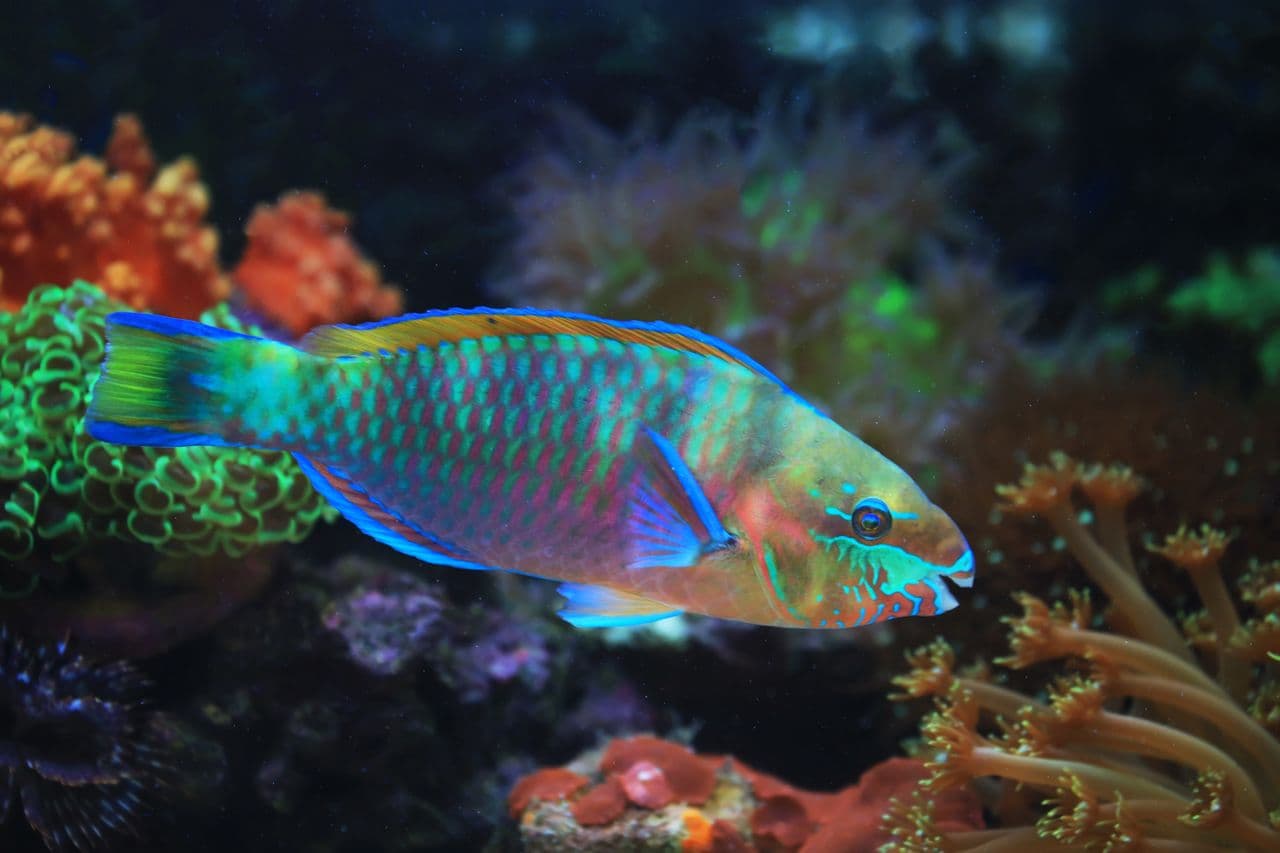
Herbivore biomass and diversity emerge across the literature as strong predictors of reef health. High herbivore biomass prevents algal overgrowth, supports coral recruitment and measurably enhances resilience; sites with abundant parrotfish and surgeonfish recover better from disturbance (Mohamad Rodzi et al., 2026). Stereo-video surveys at Pulau Bidong and nearby islands in the South China Sea have been used to quantify these assemblages directly (Afiq-Firdaus et al., 2023).
The mechanism is unglamorous and decisive. After a bleaching event, the contest for newly bare substrate is between algae and coral recruits. Herbivores decide that contest by grazing the algae down. Overfishing reduces herbivore populations, which undermines algal control and slows or prevents coral recovery, and the research treats protecting herbivores as simultaneously a reef-health measure and a fisheries-productivity measure rather than a trade-off between the two.
"A parrotfish on a Malaysian reef is not a bystander to coral health. It is the maintenance crew, and the literature treats its biomass as a leading indicator of whether that reef recovers from the next bleaching event.
"
— Nemo, Fishyology Insight
Bleaching, Sediment, and an Awkward Trade-off
Malaysia has absorbed three significant bleaching episodes in recent memory: 2010, 2014 to 2017, and 2019 to 2020. Mortality was variable and ran around 5% to 6% overall, with branching genera, principally Acropora and Pocillopora, taking the worst of it (Sumayed & Hong, 2024). Repeated disturbance is now pushing community composition in some regions toward more thermally tolerant or sediment-tolerant taxa, which is a quieter kind of loss than mass mortality and harder to notice from the surface.
Sedimentation produces the most counterintuitive result in the synthesis. Chronic sediment load reduces coral growth, demonstrated directly for Acropora formosa on Tioman's fringing reefs (Nakajima et al., 2013), and Malacca Straits reefs are now dominated by sediment-tolerant species as a consequence of persistent turbidity and land-based runoff (Safuan et al., 2018). Yet turbidity also lowers irradiance, and lower irradiance reduces the odds of bleaching during a thermal event. Sediment is not therefore a hidden benefit. It buys a measure of thermal protection at the cost of slower growth and a narrowed community, which is a poor trade over any timescale that matters.
These do not act in isolation. Local, global and biological pressures compound, and a reef already carrying local stress crosses the threshold at a lower level of thermal stress than one that is not. That interaction, rather than any single pressure, is what decides which reefs recover.
Predators and Pathogens
Crown-of-thorns starfish (Acanthaster planci) outbreaks cause rapid coral loss, falling heaviest on Acropora. Removal programmes have been trialled at Pulau Tioman Marine Park and offer only temporary relief (Chak et al., 2018), which is a finding worth sitting with: the intervention works locally and briefly, and does not address whatever is driving the outbreaks.
On the pathogen side, Vibrio species have been identified as agents of white syndrome coral disease at Tioman Island Marine Park (Khodzori et al., 2021). Disease prevalence correlates with pollution and warming, which means the microbial story is not separable from the water-quality story or the climate story.
Restoration Works, at a Scale Worth Understanding
Coral nurseries and transplantation are established practice in Malaysia, and the literature on them is refreshingly unromantic about their limits. Survival and growth are species-specific, and outcomes hinge on unglamorous operational choices: attachment method and depth selection as much as site selection.
Comparative work on branching Acropora formosa measured growth differences between natural reef habitat and in situ nurseries, which is the sort of baseline that tells a programme whether it is actually accelerating anything (Xin et al., 2013). More useful still, relative return-on-effort scoring has been applied to a Malaysian nursery to judge whether the output justifies the labour consumed (Henry et al., 2023). That framing matters because restoration competes for the same limited attention and funding as protection, and the two are not equivalent: a nursery replaces coral one fragment at a time, while herbivore protection and water-quality management keep whole reefs in the game. The research supports restoration as a complement to those measures, not a substitute for them.
What the Reef Pays Back
The economic case is where this literature becomes unusually concrete.

is the return on investment recorded for some Malaysian artificial reef programmes.
Artificial reefs are documented to enhance fish stocks, raise catch value and reduce operating costs for artisanal fishers in Terengganu. This is one of the few interventions in the synthesis with a measured financial return attached rather than a projected one.
Source: Sapehee et al., 2026; Sidique et al., 2016
Ecotourism carries a comparable story with a sharper caveat. Redang Island Marine Park generates substantial local employment, with 938 jobs recorded, though economic leakage limits how much of that value stays in the community (Yacob et al., 2007). Well-managed marine protected areas show higher biodiversity and fish biomass, but the literature is consistent that sustained benefit depends on inclusive governance rather than designation alone (Islam & Nayak, 2025). Where communities participate genuinely, conservation and socio-economic outcomes both improve; where participation is nominal, neither does.
The Constraint Is Governance, Not Knowledge
Running underneath the ecology is a structural problem the research names directly. Malaysia manages reefs through a decentralised framework in which national strategy is implemented at state level with technical support from NGOs, and that arrangement produces jurisdictional complexity, fragmented policy and limited inter-agency coordination. The federal constitutional division of authority over marine environmental law is itself part of why enforcement is uneven (Mukhtar & Mustafa, 2012).
The participation literature identifies the same pattern from the other direction. Awareness, perceived benefit, incentives and local leadership drive genuine community engagement; socio-economic disparity, operational and structural obstacles, and the absence of real avenues for participation suppress it. Community-based ecotourism and co-management consistently outperform top-down designation on both conservation and livelihood measures.
The implication is uncomfortable but clear. The binding constraint on Malaysian reef outcomes is not a shortage of ecological understanding. Herbivore protection, water-quality management and site-level monitoring are all well characterised. What is missing is the coordination and local legitimacy to apply them consistently across a coastline governed in pieces.
Where the Evidence Runs Thin
Three gaps recur often enough to count as priorities rather than caveats. Borneo and several underrepresented taxa remain comparatively unstudied relative to the east coast of Peninsular Malaysia, which skews the national picture toward the best-surveyed reefs. Standardized, integrative monitoring methodologies, combining remote sensing, AI-assisted analysis and community-collected data, do not yet exist in a form that makes studies readily comparable. And climate impacts on lesser-studied taxa and feedback mechanisms are not well understood (Yu & Wee, 2023).
Worth noting what the field is building to close these gaps: deep-learning systems for automated reef monitoring are now operational (Younes et al., 2025), and citizen science mapping through Reef Check Malaysia has been shown to generate data usable for marine park management (Lau et al., 2019).
Applied Significance for Malaysian Anglers
Four things follow from this for anyone fishing Malaysian coastal water.
The national coral cover figure is not useful to you. Site-level condition varies by more than two to one, and the average is a statistical artefact of collapse and recovery cancelling out. Judge the water in front of you.
Parrotfish and surgeonfish are reef infrastructure. Taking them carries a second-order cost that the research is unusually clear about: fewer herbivores means slower recovery after the next thermal event, which eventually means fewer of everything else. That is a harder argument to dismiss than a generic appeal to restraint, because it runs through fisheries productivity rather than around it.
Artificial reefs are among the few interventions with a measured return for working fishers, not just an ecological rationale. If reef enhancement comes up in a local fisheries context, the evidence base behind it is real.
And the monitoring gap is partly addressable by people already on the water. Reef Check Malaysia's citizen science programme exists because trained volunteers produce data that management can act on, and the spatial bias in the literature is precisely the sort of thing more eyes in more places would reduce.