Fishyology Insight
87% of Malaysia's Freshwater Fish Are at Risk.
Malaysia's freshwater, estuarine, and marine systems together support 1,951 documented native fish species across 704 genera and 186 families, placing the country among the most ichthyologically diverse in the world (Chong, Lee & Lau, 2010). That diversity is not evenly distributed, nor is it evenly secure. Forty-eight percent of all native species are currently classified as threatened; within freshwater systems alone, the figure rises to 87 percent, and two freshwater species are already recorded as extinct. These are not provisional estimates awaiting confirmation. They are the settled conclusion of a research literature spanning ichthyology, molecular ecology, environmental science, and fisheries management, concentrated mostly in the period since 2015.
This piece synthesizes that literature, drawing on a corpus of Malaysian fish research assembled and summarized via Scopus AI, with every claim checked against the underlying publication before inclusion here. The intent is not to reproduce the academic record wholesale but to extract what is load-bearing for readers who fish these waters directly, people for whom "87 percent of freshwater species at risk" is not an abstraction but a description of the pond, river, or reservoir they were standing in last weekend.
Scope and Method of the Synthesis
The underlying literature spans field surveys, taxonomic revisions, molecular phylogenetics, environmental DNA (eDNA) metabarcoding, citizen science, predictive habitat modeling, and policy analysis, concentrated across the 2010–2024 window with a pronounced skew toward research published after 2015. Three limitations are worth stating up front, because they shape how confidently any of the following figures should be read. First, genetic reference data exist for only an estimated 68 percent of freshwater species, which constrains the accuracy of DNA-based identification for the remainder. Second, sampling has historically concentrated on accessible or economically significant regions, leaving remote river systems and peat swamp forests comparatively under-surveyed. Third, quantitative population-trend data for critically endangered species across 2015–2024 remain sparse, meaning the literature can often establish that a species is declining without being able to say precisely how fast.
Taxonomic Diversity and Persistent Uncertainty
Malaysia's native fish fauna divides unevenly across three habitat types, and the relationship between how many species a habitat holds and how many of them are in trouble runs in opposite directions, as Figure 1 shows.
Freshwater habitats hold the fewest species of the three categories and, by a wide margin, the highest proportion at risk, a pattern consistent with the general ecological principle that confined, non-contiguous systems concentrate pressure more severely than open ones. A marine species displaced from a degraded reef retains some capacity for range shift; a cyprinid endemic to a single disturbed headwater stream typically does not.
Taxonomic resolution within this fauna remains unsettled in several economically and recreationally significant groups. A 2018 revision of the genus Poropuntius in Peninsular Malaysia found that only P. normani is a valid taxon, with P. smedleyi reclassified as a junior synonym (Muhammad-Rasul et al., 2018). Cyprinidae more broadly, along with genera such as Barbonymus and Puntius, continue to exhibit unresolved synonymy and cryptic diversity, meaning that what field guides and anglers treat as a single species may, on molecular inspection, resolve into several. The family Syngnathidae (pipefishes and seahorses, numbering around 50 Malaysian species) shows comparably high cryptic diversity alongside patchy distribution and documented overexploitation pressure.

of lotic (river-dwelling) freshwater species in Malaysia are restricted to a single state.
Nearly half the river fish fauna occupies a geographic footprint narrow enough that a localized habitat collapse, a single impoundment, or one serious pollution event could plausibly eliminate a species across its entire known range.
Source: Cheok & Soo, 2022
Population Status and the Distribution of Risk
Of the 1,951 recognized species, 35 are considered threatened specifically on account of endemism, meaning their restricted range is itself the primary risk factor rather than a secondary compounding one. Regional variation in richness and abundance is well documented: northern river systems such as Beriah Kanan carry measurably higher species richness than comparable southern systems such as Ulu Sedili, and estuarine habitats such as the Matang Mangrove Forest Reserve support disproportionately high diversity, with 42 species recorded across its three constituent estuaries. This unevenness matters for conservation prioritization. A national-level statistic (48 percent threatened) obscures the fact that risk is not spread uniformly across the map; some river systems and estuarine reserves function as disproportionately important reservoirs of remaining diversity, while others have already been substantially depleted.
Anthropogenic Pressures on Native Assemblages
The literature identifies habitat degradation, water quality decline, overfishing, and invasive species as the dominant, well-documented threats to native fish assemblages, with sedimentation and turbidity constituting a further, more specific pressure on reproductive success. Urbanization is shown to reduce fish diversity and homogenize species assemblages across affected stream systems; oil palm plantation development alters stream structure and community composition, though certain endemic species persist in modified habitat at reduced abundance; and even low-intensity logging has been associated with measurable reductions in local species richness and functional diversity.
Water quality thresholds are comparatively well characterized. Ammonia concentrations above 0.03 mg/L are documented as harmful to fish, with concentrations above 2.00 mg/L classified as lethal; algal bloom events have been directly linked to fish mortality incidents in at least one documented Sarawak case. Turbidity above 0.125 g/L measurably reduces embryo hatching rates and increases malformation incidence in affected species, connecting sediment pollution directly to reproductive failure rather than only to adult habitat quality.
Overfishing pressure is geographically uneven, with the literature flagging the Malacca Strait and Sarawak waters as sites of particular concern, including elevated catch proportions of immature individuals, a pattern associated with population-level risk of collapse rather than merely reduced yield (Alam et al., 2024).
Invasive Species, With Peacock Bass as a Case in Point
Among the threats documented, the introduction and spread of peacock bass (Cichla spp.) offers the clearest case study of how quickly an introduced predator can restructure a Malaysian water body. The species shows rapid range expansion, facilitated by both deliberate sport-fishing introductions and pre-existing habitat disturbance, with measurable downstream effects on native community structure, including declines in small native fish abundance and altered size distributions once established populations mature (Khaleel, Ismail & Ahmad-Syazni, 2021). African catfish (Clarias gariepinus) presents a parallel, formally assessed case: a 2023 risk screening using the Fish Invasiveness Screening Kit (FISK v2) concluded that the species poses meaningful invasion risk in Sarawak waters specifically (Kiat & Rahim, 2023).
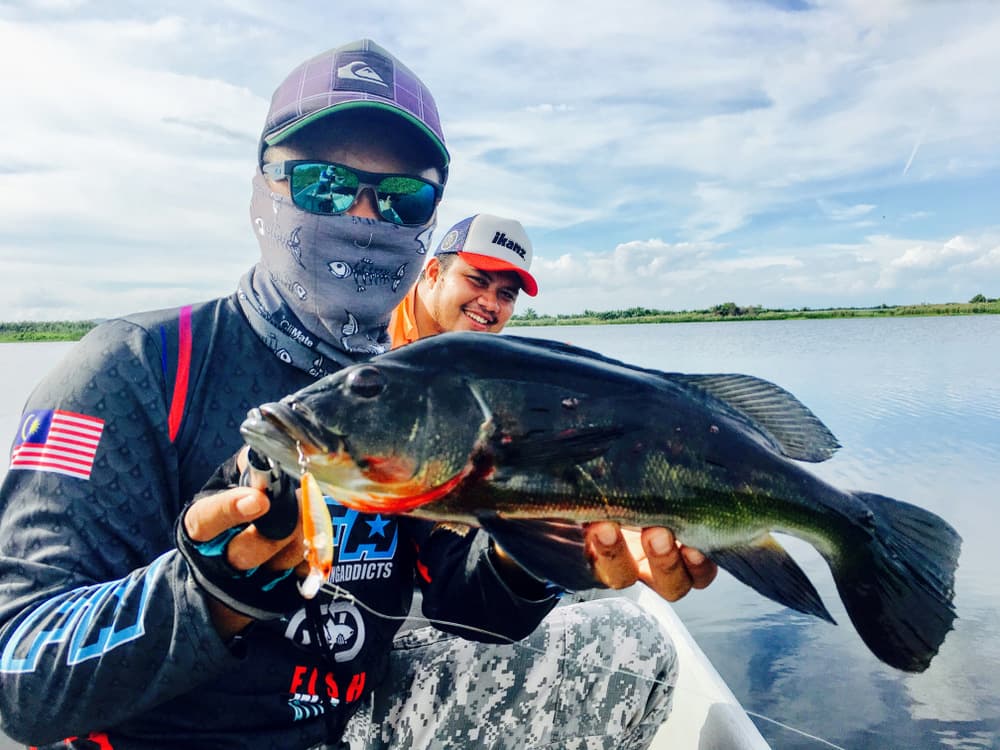
This produces a genuine tension that the research does not resolve on anglers' behalf: peacock bass are, by most accounts, an excellent gamefish, and they are also a documented ecological disruptor wherever they establish. Readers who target them in Malaysian reservoirs are operating inside that tension whether or not they have previously considered it in those terms.
Monitoring and Molecular Tools Closing the Detection Gap
The gap between documenting decline and acting on it precisely has narrowed meaningfully in the past several years, driven substantially by two methodological developments. The first is environmental DNA metabarcoding, which identifies species present in a water body from genetic material shed into the water column rather than through netting or electrofishing. A 2024 study applying short-read nanopore sequencing to Malaysian tropical rivers detected over 13 percent more species than conventional survey methods achieved, at approximately one-third lower cost (Munian et al., 2024). For a country with documented sampling gaps in remote and peat swamp habitats, this represents a material improvement in monitoring feasibility rather than a marginal one.
The second development concerns Tor spp. (mahseer) specifically. Semen cryo-banking for Malaysian mahseer has operated since 2008, with cryopreserved sperm already shown to yield viable fry (Chew et al., 2010). Germ cell transplantation, in which a surrogate species carries and produces donor-derived offspring, is presently being tested as a further measure for species considered too endangered to risk conventional broodstock management (Esa & Abdul Rahim, 2013).
"The mahseer is the clearest case in the literature of a species anglers already prize being actively engineered a path back from population collapse, not hypothetically, but with frozen sperm and surrogate broodstock, in active use now.
"
— Nemo, Fishyology Insight
The Contested Role of Citizen Science
A further monitoring channel runs through observations that are not generated by researchers at all. Citizen science platforms and social media, smartphone identification apps and public YouTube uploads among them, have been shown to supply occurrence data of genuine value for tracking both invasive and rare species, precisely the two categories where formal survey coverage is weakest (Geller et al., 2021). The literature treats this as a real contribution rather than a novelty: a volunteer's photograph of an unfamiliar fish, timestamped and geotagged, is a data point that no funded survey would otherwise have collected at that location on that date.
The same literature is equally direct about the limitations attached to that contribution. Sampling bias is substantial, since contributions cluster around accessible, populated areas in the same pattern that affects formal surveys, and reported observations generally require expert validation before they can be treated as reliable records rather than provisional sightings. The practical conclusion the research draws is integrative rather than dismissive: citizen-generated data extends the reach of formal monitoring meaningfully, provided it is paired with, rather than substituted for, expert-led verification.
Community-Based and Policy Measures
Malaysia's conservation infrastructure extends beyond laboratory tools. The Tagang and Tagal systems, indigenous-led approaches to river management practiced in Sarawak and Sabah respectively, are documented to improve both ecological condition and community wellbeing outcomes where implemented (Keling et al., 2021). At the national level, Malaysia has operated under a National Conservation Strategy since 1993, with state-level implementation supported by organizations including WWF Malaysia (Furtado et al., 2013). Predictive modeling, principally maximum-entropy (MaxEnt) species distribution models, has been applied to forecast invasion risk for six alien fish species across Malaysia, with results indicating elevated invasion potential specifically within protected areas in Sabah and Sarawak, a finding with direct implications for where enforcement resources might be most usefully concentrated (Vythalingam et al., 2022).
The literature is nonetheless candid about the limits of this policy infrastructure, citing a continued need for stronger enforcement mechanisms and more standardized conservation systems across state jurisdictions, a gap that predates most of the molecular and modeling advances described above and has not been closed by them.

of Malaysia's freshwater species currently have usable genetic reference data on file.
This is the practical ceiling on eDNA and DNA barcoding accuracy at present. An identification method is only as reliable as the reference library it is matched against, and roughly a third of the freshwater fauna has no entry to match against at all.
Source: Esa & Abdul Rahim, 2013; Teixeira et al., 2025
Outstanding Knowledge Gaps
Three gaps recur across the literature with sufficient consistency to be treated as genuine research priorities rather than incidental caveats. Quantitative, recent population-trend data for critically endangered species, specifically across the 2015–2024 window, remain limited, constraining the field's ability to move from "this species is declining" to "this species is declining at this rate." Genetic reference libraries remain incomplete, with threatened and endemic species disproportionately underrepresented relative to common species. And systematic, comparative evaluation of conservation intervention effectiveness, whether community-based programs, molecular monitoring, or policy enforcement, is largely absent; the literature documents that interventions exist and operate, considerably more thoroughly than it documents whether they are working.
Applied Significance for Malaysian Anglers
None of the preceding is an argument against fishing Malaysian waters, and the underlying research makes no such case either. It is, instead, an argument for fishing with an accurate model of what is actually present in the water. A mahseer caught and released today belongs to a population that researchers are simultaneously attempting to rebuild through cryopreserved broodstock, a fact that changes nothing about the mechanics of the catch but meaningfully changes its context. A peacock bass taken from a reservoir that did not hold them a decade prior is direct, observable evidence of the invasion pathway the literature has been tracking in close to real time. The distance between the published research and the person holding the rod is, in most cases, simply a distance, not an unbridgeable gap; closing it requires comparatively little beyond engaging with research that already exists and is already specific to the water being fished.